Controlling The Chinese Parasol Tree In West Feliciana Parish, Louisiana |
this introduced pest is now recognized nationwide as a
major biological threat — managing the |
 |
text / photos by John Siebenthaler June, 2006 (rev. 2008 | 2013 | 2021) info |
resources and links |
A Rank Ornamental Nightmare Runs Loose In The LandscapeThe comments and opinions contained in this guide to controlling Firmiana simplex are suggestions only, based solely on the experience of the author, and in no way are the treatment results guaranteed. The intentional use of CPT is typically in an urban environment — courtyard, backyard or commercial plantings as a fast-growing focal point. Unfortunately it’s a very short leap to the incredibily dense forest takeover that can quickly suffocate virtually every other understory plant in the woods.
The occasional use of this tree sets the stage for escape. Once CPT escapes, using a very efficient system of seed distribution helicoptered into any surrounding woodlands, a well refined campaign of stealthy advancement begins. Left unchecked, the plant explodes into a full blown invasion that’s difficult to control on a small scale and nearly impervious to modification in larger areas. |

(ST. FRANCISVILLE, LA) The introduction of Firmiana simplex, aka CPT — Chinese parasol tree, or just parasol – in West Feliciana parish is thought to have occurred sometime in the early to mid-20th century. The original source of the non-native hardwood infestation is believed to be on – or near – Rosedown Plantation.
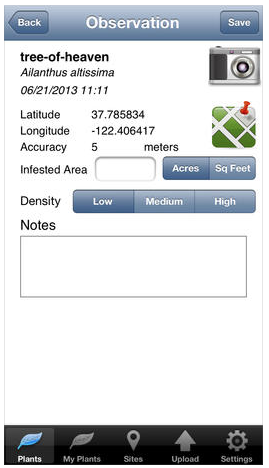
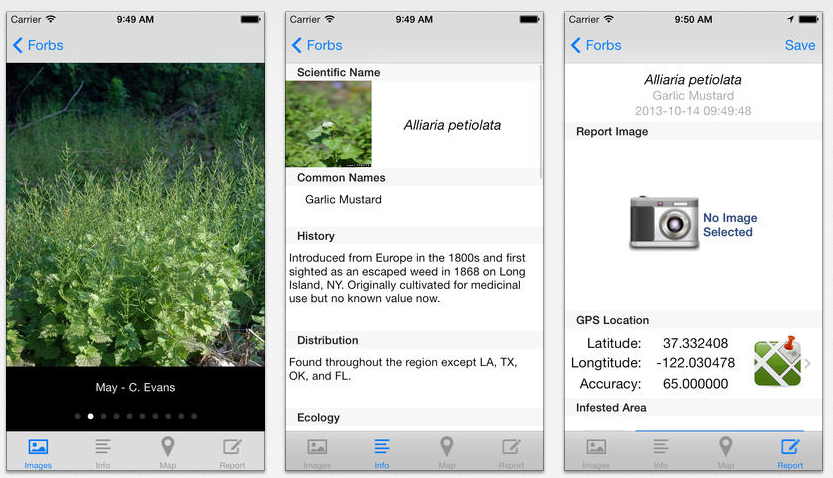
The U.S. Forest Service Field Guide for the Identification of Invasives in Southern Forests is available as both a PDF and a mobile app (below) for smart phones or tablets. The app allows GPS based reporting of invasives from the field in addition to localized identification. You’ll find Chinese parasol detailed on page 10.
Little more than five decades later numerous locations throughout the parish have been completely overrun by the aggressive invader, suffocating hundreds of acres of native vegetation, wreaking environmental havoc, and creating a control nightmare in the process.
Factual or not that first innocuous planting, regardless of origin, marked the arrival of an invasive pest whose subsequent takeover of the environment everywhere its gained a foothold is astounding. (resource links)
When – not if – the prolific breeder escapes into the wild there’s little to slow it down. The tree’s perfect camouflage lets it blend in undetected, rendering the damage invisible until it’s too late.
Once able to recognize the distinctive crown, observers can easily detect the invader. In St. Francisville, the CPT-infested woods bordering Commerce Street around Sullivan Dental Center and Wyoming Plantation illustrate both the extent of the problem and the extreme difficulty of selectively correcting the situation.
Setting The Stage For Total Domination
How tough are Chinese parasol? They survived the Hiroshima atomic bomb from a distance of 1.3 kilometers. Comparisons to kudzu are obvious. It’s probable that in a gardening shootout, the landscape strangling vine could emerge as the dominant invasive of the two, but CPTs ability to gain a formidable foothold in a variety of habitats remains impressive.
CPT may have once been aggressively planted as a quick source of forest revenue to augment the region’s soft and hardwood forestry products, but as lumber it’s worthless.
Its benchmarks – fast, straight, self-limbing growth – that are responsible for the nightmare’s supremacy in a native habitat still look at first glance ideal for timber, or as some think, a failed pulpwood experiment. The wood is too light and soft – thus no economic reason for culling.
This leaves West Feliciana and surrounding parishes suffering from the silent invasion with a super green control headache and no possible hope for eradication. There may be a biological control that could be brought to bear but so far the only natural threat seems to be cottony scale at a young age, which when observed seems hardly to have had much impact beyond scaring the trunk. back to top
I use Sawyer’s Permethrin Clothing and Gear Insect Repellent for complete protection against all types of insects, especially ticks. I treat everything from socks to hats with good success against bites and stings.
A Nationwide Designated Invasive Species
They’re everywhere – you just can’t see them. A CPT takeover is powered by sheer numerical advantage that kills off most other plant forms by denying them the air, water, sunlight and nutrients necessary for survival.
Whether as seedlings, saplings or mature trees, they’ve evolved to successfully block light from reaching the forest floor regardless of growth stage, thereby preventing all but a few hardy indigenous species from surviving.
From Savannah, Georgia west to Austin, Texas and Santa Barbara, California, this pest is recognized nationwide as a major biological threat in varying stages of prohibition and is listed by the U.S. Department of Agriculture as such on the invasive species web site. Unfortunately, Louisiana to date has yet to fully address the horrendous environmental and economic impact of this uncontrolled invader.
It continues to be a recommended landscape species by the LSU Ag Center in its downloadable (pub1622treesLOWRES.pdf) publication Trees for Louisiana Landscapes, as well as numerous other publications, even as the state provides grants specifically for the removal of CPT.
Other notes: native of China, naturalized across the southern United States from N. Carolina west to California, grown as far north as Washington, D.C. and readily available online and from nurseries.
That’s the background. For any successful reclaimation to succeed, mature seed producers need to be totally eliminated, and at nearly twice the commonly stated height of 40 feet and up to two feet in diameter, this can be a daunting, dangerous, expensive, and labor intensive task.
Identifying CPTs Seeds of Destruction
Drought tolerant and cold hardy, this messy deciduous intruder quickly spreads, becoming so dense in just a few seasons that what from only a few feet away looks like a healthy forest is in fact a single species monosystem, rivaling other despised and horrendously destructive pests like Chinese tallow, Brazilian pepper, and Melaleuca.
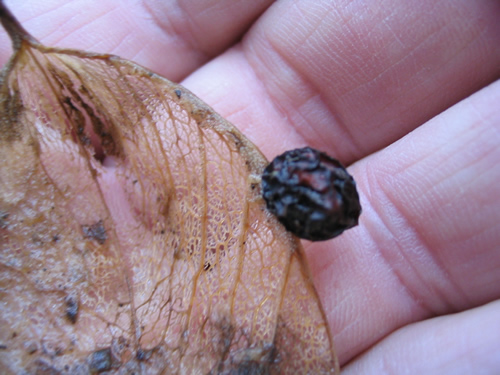 The well-adapted pest flowers in spring and early summer. Each bloom forms five fruits that end up splitting open like a leaf after first oozing a brown, tea-like liquid. The leaflike appendage bears multiple seeds that after launching their airborne assault flutter daintily earthward towards a soft landing in our fertile West Feliciana habitat.
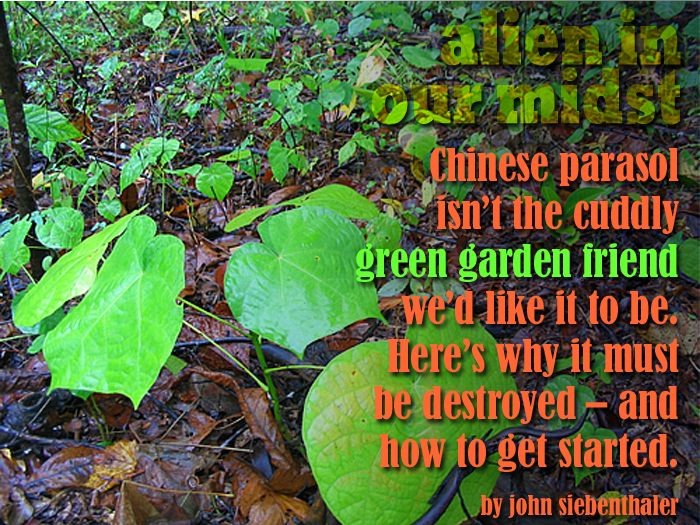
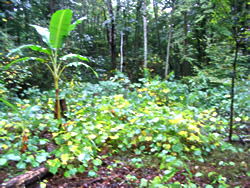
Hallmarks of the tree, with it’s signature parasol crown, include incredibly fast growing nurseries that quickly form a relentless suffocating canopy just a few inches off the ground. Notice the newly sprouted colony in the photograph at the top of the page. After the seed bearing parent trees were cut down these first-year seedlings germinated as soon as the sun hit them. Left untreated, they grow at a phenomenal rate and upon reaching maturity perpetuate the cycle.
The seeds — unusual in that they’re arrayed around the perimeter of the ersatz leaf (above left) — are well designed for widespread aerial dispersal from heights of 50, 60, 70 feet and higher. They drift down or are scattered by the wind in overwhelming numbers that easily germinate in massive quantities, rapidly suppressing through sheer numbers even the hardiest plants. For a look at the tree’s growth and appearance characteristics, visit the LSU AgCenter/School of Renewable Natural Resources web site.
|
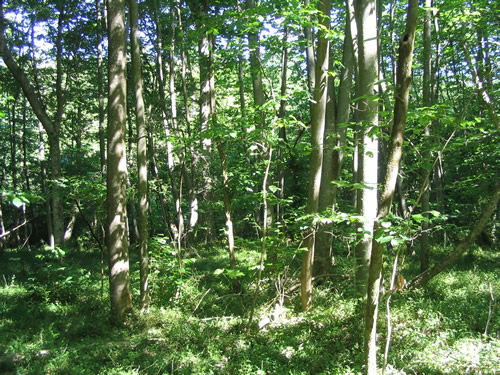
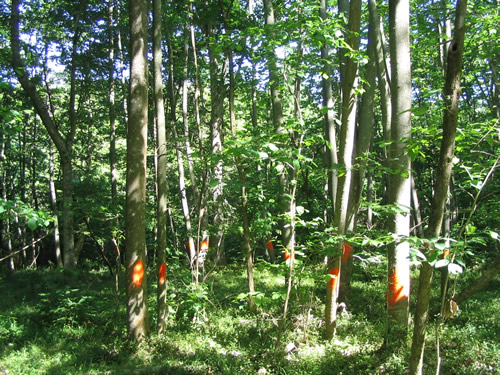
Parasol Hide And SeekParasols escape detection by masquerading as a healthy forest (top).CPTs were highlighted with surveyor’s paint, demonstrating how effectively they are in taking over wooded areas (bottom). |
Native Habitat Under Siege
Our introduction to CPT began in 1999 on eight wooded acres off LA-10 just east of St. Francisville. Formerly part of historic Rosedown Plantation, we’d explored the property several times before buying and, being unfamiliar with CPT, assumed it was part of a healthy hardwood forest ecosystem.
Throughout the property there were ones and twos of other native varieties: sweetberry, a scattering of various oaks (Shumard, water, laurel, cow), ironwood, and two veteran magnolias. Old growth beech and plenty of sweet gum are the only species existing in any numbers, while patches of silver bell and dogwood have managed to hang on in the few areas of heavily shaded woods to escape encroachment.
But the overwhelming dominant tree throughout was Firmiana simplex, by the many hundreds of mature trees, thousands of understory saplings, and tens of thousands of seedlings on our acreage alone.
As Floridians new to the Felicianas, we’d even been told by the realtor there was side money to be made were we to set up a roadside stand and sell them to passersby. To our dismay we soon discovered that nurseries throughout the region, both wholesale and retail, sold and continue to sell to this day CPTs as being ideally suited for residential landscaping.
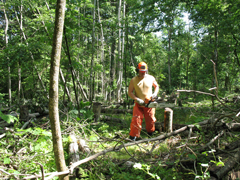
Once we realized the scope of the infestation, we naively set about the task of removal with a lone 16-inch chainsaw, compound lopping shears, and an occasional three-gallon backpack full of herbicide. Make no mistake — once infested the process of clearing or controlling to the point of occasional maintenance is long and arduous. But it can be done. back to top
Parasol Destruction Game Strategy
The prolific and efficient production and distribution of Firmiana seed requires that seed sources be interrupted as the first step in bringing the pest under control.
Pay close attention when felling — these unpredictable toothpicks fall anywhere, anytime, without warning.
Little is known in this country of the overall characteristics of the plant. Germination rates, viability, life span – there’s just not much literature available for guidance.
The only qualified field study on control was done here in West Feliciana by Louisiana State University’s AgCenter Area (Clinton office) Extension Forester Brian Chandler. Download his excellent 2001 controlled trial that evaluated the hack and squirt seasonal application of eight industrial strength herbicides.
The Problem Is Clear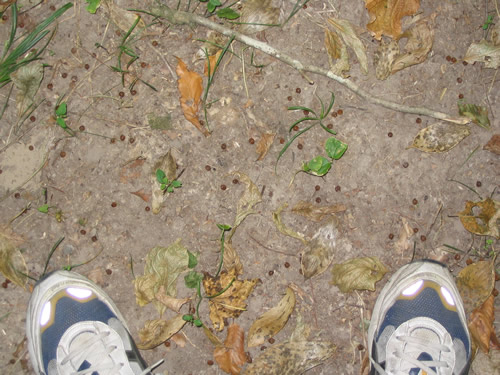
Seed distribution in a heavily infested area. Removing the canopy allows thousands of fallen seeds to quickly germinate, while seedlings and saplings react vigorously to their sunny new environment. Seedlings are easily controlled using either spray or mechanical (mowing) methods. |
Brian's tried and tested hack and squirt method uses a sharp hatchet to first slash the extremely tough mature bark several times, followed by a dose of full strength herbicide sprayed directly into the wound with a squirt bottle full of glyphosate (RoundUp), developed by Monsanto and now marketed by Bayer.
He’s able to cover ground quickly, allowing the tree’s own hydrology to distribute the chemical from the canopy to the roots for 100% die-off based on a single treatment that can be administered nearly any time of year. (Note: glyphosate is also available as a less expensive Monsanto-branded Honcho 41% solution in 2.5 gallon quantities.)
This method is very efficient, especially for treating larger trees, but there is one drawback to hack and squirt: the trees quickly die in place, but don’t decay as rapidly as when felled to the ground.
Depending on your situation — and the size and height of your trees — the unpredictability of having a forest of 30 to 70-foot tall dead trees overhead, potentially numbering in the hundreds and ready to topple or collapse without warning, may not be a desireable condition.
And although the mature trees are dealt a death blow, their progeny will have to be sprayed several times. Doing so among a forest of ready to topple trees may present a problem, as could fire, with so much potential fuel stored vertically like a parade of matchsticks ready to ignite.
Compared to the alternative (chain saw) though, hack and squirt is definitely much safer to administer initially, easier and faster to apply, less destructive of any adjacent beneficial vegetation, and 100% effective in killing the tree and any subsequent suckers.
Most importantly, it is also effective in delivering the critical first step: immediate and thorough elimination of the seed source. For more details, call the Clinton office.
Incorporating A Chemical Control Solution
Thanks to their large leaf area and rapid translocation, CPT is very susceptible to use of a targeted herbicide. My preferred procedure is to first cut down mature seed bearing trees and then spray the seedlings and smaller saplings with a 1.5% (2 oz/gal) Brushmaster® solution combined with a few drops of dish soap added as a surfactant and several ounces (per 4 gallons) of ordinary rubbing alchohol (isoproponal) as a penetrant.
Even at this low concentration, a drenching spray that girdles parasol green bark is very effective in killing the tree.
Brushmaster® is an economical combination spray featuring dicamba, a pre-emerge herbicide that acts as a disruptive growth hormone, and 2,4-D. Although deadly for the parasol it’s use is forgiving of non-weedy grasses that are essential to erosion control. (Because it is a pre-emerge herbicide, take caution to avoid the roots of desireable trees and ornamentals.)
You can review the Brushmaster® label here, and review the Invasive.org Center for Invasive Species and Ecosystem Health's characteristics of 2,4-D and half-life (10 days) by downloading the PDF on this website.
UPDATE August, 2017: One of Brushmaster®'s primary ingredients is dicamba, which is also the main component in XtendiMax herbicide, sold by Monsanto for use on its proprietary Xtendiflex soybean hybrid seed. Arkansas and Missouri have temporarily banned the use of dicamba because of extensive damage to other crops due to drift which is said to have occured after use of off-brand herbicides containing dicamba and 2,4-D.
Ideally, a non-invasive biological control would be developed — I’ve occasionally observed cottony rot colonizing on the trunk, suggesting a biologic could be useful. Until then, the sheer enormity of the problem means chemical control, especially of established nurseries, is the only solution to help eradicate the pest.
If you choose to use Brushmaster®, please read the label carefully and follow all instructions for safe application.
Fortunately, the wide leaves of the parasol are hard to miss and offer plenty of surface area to absorb treatment, retaining most of the applied spray. The relatively low dilution rate, which breaks down quickly after application, also minimizes the threat to desireables. Please follow all safety precautions when applying this or any other chemical control.
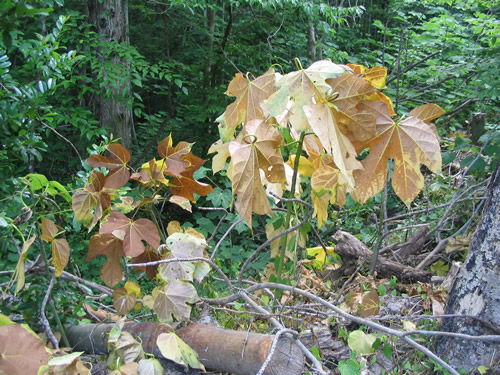
The yellow foliage in a patch of sprayed seedlings indicates the very effective disruption of chlorophyll cells. I use the same solution for an equally destructive green bark application of saplings whose canopy is beyond reach of a sprayer, and to thoroughly saturate the surface of the cut stumps to insure they’re completely destroyed. (Click here to access complete product descriptions, including labeling and product information sheets.)
A Little Spray Goes A Long Way
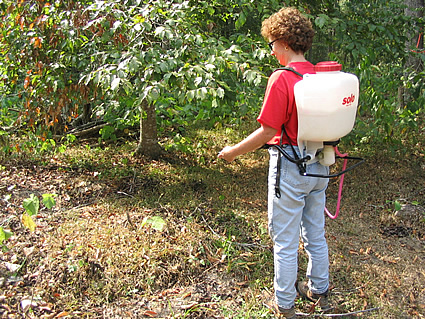
Delivery is straightforward: a medium to coarse mist from a backpack sprayer is applied as a foliar to the point of runoff. Spraying the trunks of green bark saplings is especially handy in the ravines and prompts collapse without a trace within a season or two of treatment. I also spray freshly cut stumps with the same solution, and when liberally applied there is virtually no residual suckering.
Although Brushmaster is recommended only for April through August application, I’ve had excellent success regardless of the month. In winter my primary method has been as a green bark or cut stump application.
The cut surface/basil bark dilution rate recommended by the manufacturer for mature trees is 10 oz/gal-diesel. This is where the hack and squirt method can also be used. Both approaches should be considered very effective, especially on difficult terrain. back to top
Hit ’Em Where It Hurts A back pack sprayer allows precise application to control seedlings and is especially useful on steep slopes where mechanical control isn’t practical. A coarse spray is easily controlled. A few days after spraying, impact on second year seedling (above) is obvious.
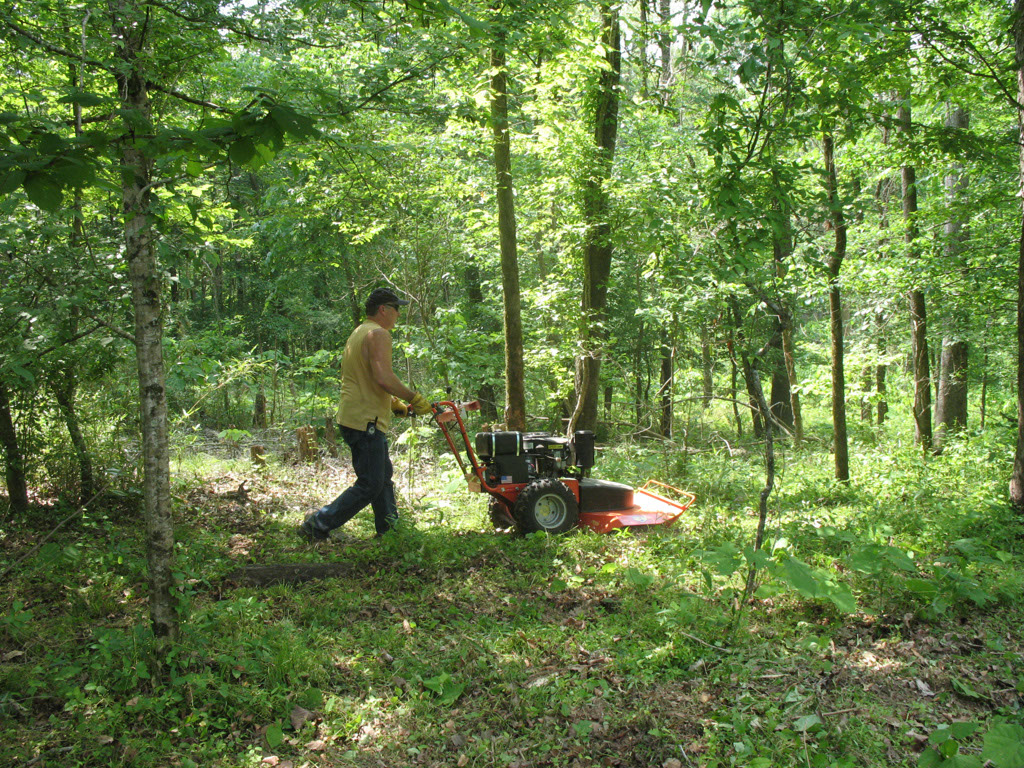
My DR walk behind brush mower easily navigates the rough terrain and slopes while whacking parasols up to three inches in diameter.
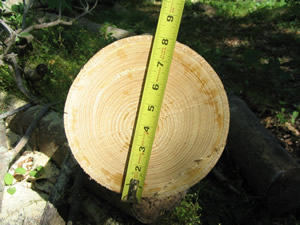
A stump diameter of 8"-12" inches is common. One tree measured 70-feet in height.
|
There are any number of potentially effective herbicide combinations that could be equally efficient, including Grazon®, another combination herbicide containing 2,4-D and the systemic picloram. Often used by utilities for controlling brush along transmission lines, the issue of a systemic could be problematic.
Both the choices listed above are selective. Non-selective glyphosate (RoundUp®) is familiar, commonly available, inexpensive in it’s generic form, and popular. But because it’s a broad spectrum herbicide that kills all vegetation indiscriminately I’m hesitant to use it, particularly in the ravines where any loss of erosion control has negative consequences.
Saw. Spray. Mow. Repeat.
Control begins with a methodical chain saw attack on mature seed sources. When possible I limb and section the trees after felling as an aid to decomposition. The more cuts that can be introduced, including a new strategy of slitting the bark lengthwise to allow penetration, the quicker moisture and insects can begin the process of composting.
Light mowing and string trimming are effective for plants in the nursery stage. Parasol bark, though, is extremely tough. I first tried a DR 5-hp walk behind string (.175mm) mower but even that can’t cope with stems larger than 5/16" or so without stripping out the cord.
Adding a 15-hp DR Field Mower solved the mowing challenge. When the optional Brush Blade is added, the mower can cut down saplings up to two inches in diameter.
Suckering from cut stems is a problem and successful control may take more than one pass. Seedlings that were sheltered from the sprayer by the overhead canopy will survive, but their numbers diminish significantly once seed sources are eliminated.
Retreatments — spraying, mowing or both — will be required over several seasons until the residual seeds are no longer viable, all seed sources have been destroyed, and all seedlings are dead.
While mature trees (gray bark) require aggresive measures to bring under control, the green bark stage is easily subdued by sawing, cutting, or spraying.
Saplings are generally one to three inches in diameter. They’re easy to snip using compound lopping shears. Cutting alone, regardless of tree size, needs prompt stump spraying because of the sucker growth that always occurs.
Parasol Benefits? None At All
Chinese parasol has that single characteristic common to most invasives: cheap to buy and very rapid growth, which all too often is the most favorable trait cited by homeowners when purchasing plants for casual use.
Straight and self-limbing, they’re favorites for ornamental use in courtyards and small space gardening, and have been widely promoted for urban situations.
They remain a recommended species in the LSU School of Landscape Architecture and are sold in nurseries and garden centers throughout Baton Rouge and Louisiana.
Rotten To The Core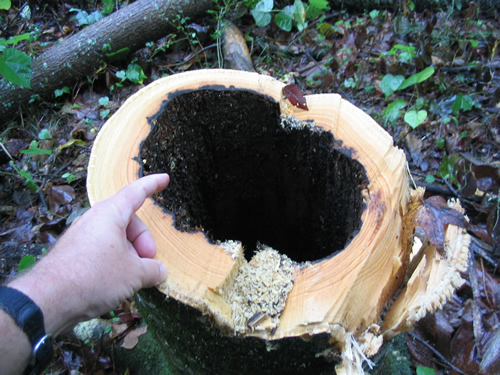
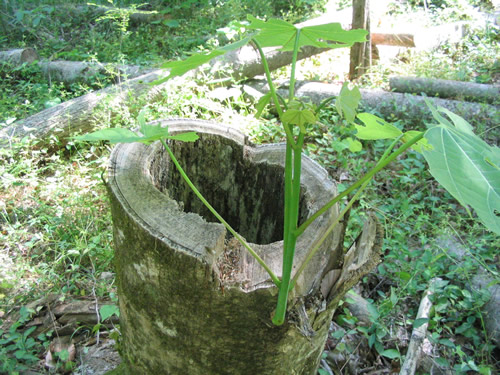
Tree at time of cutting (top) and six months later. There was no outward sign that the trunk was hollow – and extremely dangerous. Suckering will occur if the stump’s not sprayed. Regrowth won’t grow to maturity but will compete for light, water, air and nutrients. |
CPT offers no useful habitat for wildlife in terms of nesting, browsing, or other beneficial attributes, and a best guess parasol lifespan in the Felicianas might not be more than 40 or 50 years in the most heavily infested areas.
There is a thought that CPT helps retard soil erosion. In fact it’s a very unstable tree with a propensity for rot and a relatively shallow root system. It’s easy to find trees that have toppled over when not supported by a dense tangle of neighboring parasols to lean on, due to rot or insufficient root support. In fact, the native vegetation it eliminates is much better suited for erosion control.
Interior damage to an outwardly healthy tree is difficult to detect, and the results can be sudden and dangerous. The core of the tree in the photos at right was completely hollow, the result of an old wound and opportunistic carpenter ants. Externally, there were no visual indications of any weaknesses in this 40-foot tall intruder growing beside a favorite path.
Why hadn’t it fallen? Because the trademark arrow-straight growth habit and lack of branching makes for an easy balancing act, one that’s quick to fail when high winds and/or unstable (rain saturated) soil become factors. Even when a tree’s been properly notched during cutting and there aren’t any obstructions to hang up on, they don’t always fall as predicted.
Give Nature A Chance
It’s up to us to help. Begin by learning how to identify the invader, so you can point it out to your friends and community. If you see it used in a commercial setting, let the shop owners know about the threat. Document occurances and use your own social media to spread the word. Parasols are a serious problem that’s silently getting worse, but a public that’s aware can help slow it down.
Over the course of our multi-year campaign to renew the habitat, I’ve cut down hundreds of trees and we’ve sprayed, lopped and mowed tens of thousands of saplings and seedlings. Those efforts are paying off, as diversity responds to fill the void left by the departed parasols.
Not everything is welcome: privet has emerged with a vengeance and we’ve treated the vicious invasive trifoliate citrus with spray as well. But measured against the tenacity of CPT, dealing with the upstart intruders will be like a walk in the, well, woods. back to top
all © john siebenthaler 2006-2023 |  siebenthalercreative.com siebenthalercreative.com |
You can help spread the word by joining the conversation on the Chinese parasol Facebook page. You can also contribute by registering your CPT sightings on the University of Georgia’s EDDMapPs (Early Detection and Distribution Mapping System) web site, part of The Nature Conservancy’s educational effort.
Reclaiming A Forest4 steps for controlling Chinese parasol tree: begin at the beginning
Step 4 will take several seasons or until all viable seed and sources are destroyed. There’s no information on how long seeds remain viable. Controlliing the seedlings once the seed source is removed is relatively easy when the terrain cooperates. Caution! Parasols Can Be Extremely Dangerous!Rotten cores and frequent snags combine to create widow makers in heavily infested areas. When using a chain saw have an escape route, be aware of your footing and keep your equipment in peak operating condition - including a sharp chain. 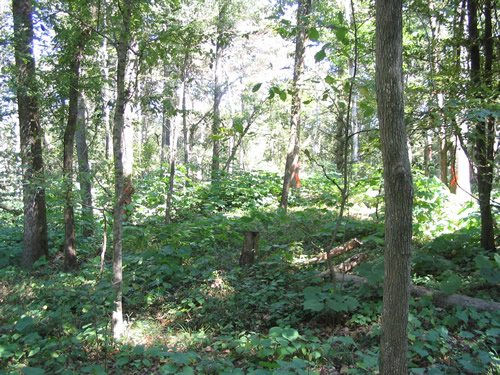
This steep hillside is densely carpeted with CPT seedlings – clear evidence of seed bearing adults in the vicinity. These pop-up nurseries are easily controlled with minimal spraying. 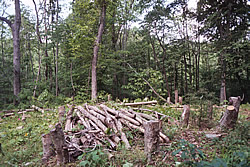
Wood usually rots within several years of cutting. Stumps take longer, but in general debris is composted in a relatively short time. 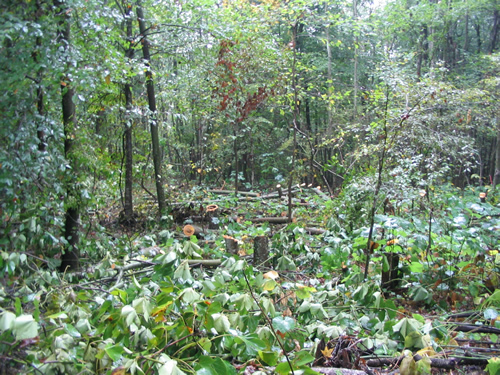
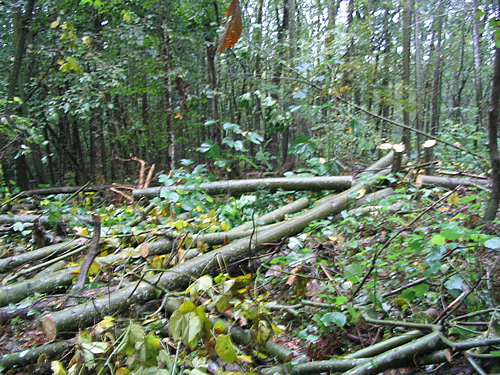
Freshly cut area (above) was nearly impassable prior to clearing. Trunks (below) were limbed and bucked to speed decomposition.
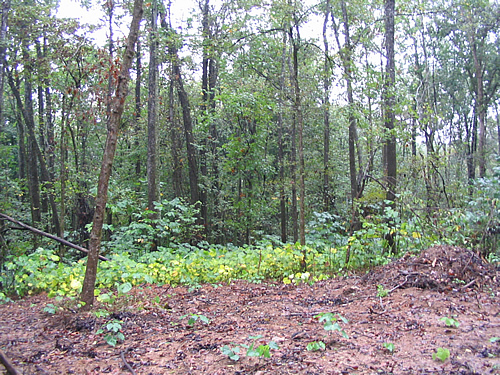
A line of vulnerable new seedlings, quick to sprout in disturbed soil, has been freshly sprayed. Leaf yellowing indicates cellular disruption of the plant’s chlorophyll. 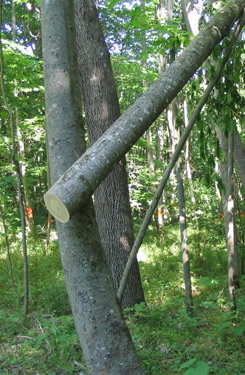
Snags are common. A result of dense colonization that’s characteristic of parasols the crowns easily interlace, preventing the trunk from falling. 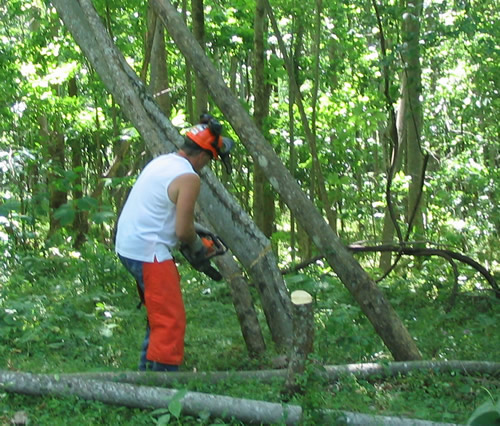
A clump of several intertwined trees that hung when cut. Decay and wind will bring this group down. Always remain alert to the threat of widowmakers. 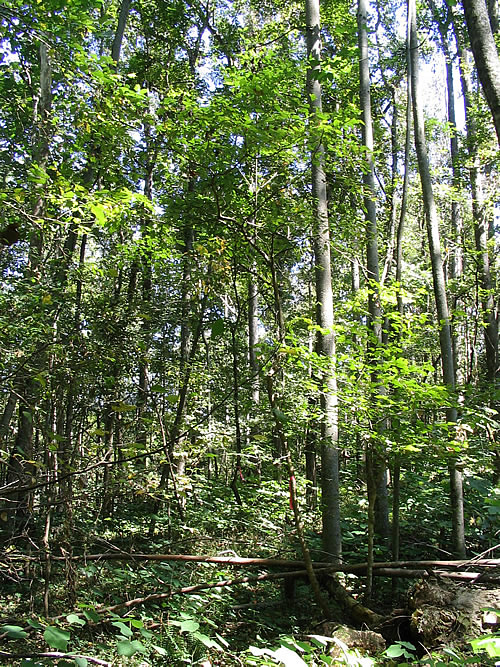
A tangle of fallen trees crisscrosses this thicket of CPT. Very crowded conditions mean extreme care must be taken when cutting. Most references cite mature heights of 30-40 feet, but they easily grow much taller — 70 feet plus is not uncommon in our area. 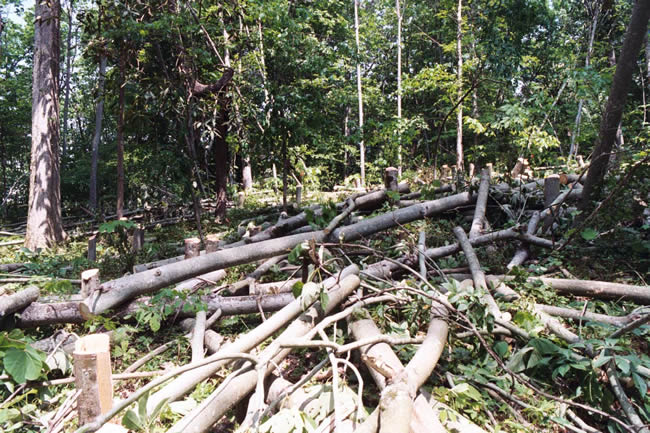
This hillside patch, cut in February, 2004 and left undisturbed, was 60-70 percent decayed by September, 2005. The remainder, primarily stumps and large trunks, took a few more years to decompose. Helpful Links:
|
 We’re honored to be part of the